 Crush The Castle
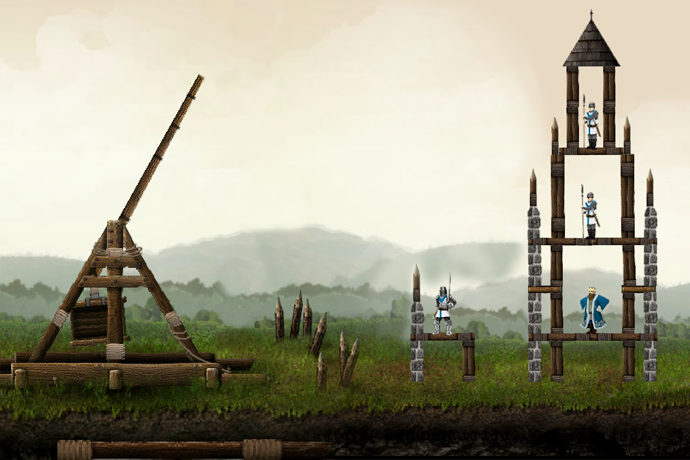
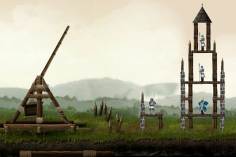
When I think back to Crush the Castle, it feels like one of those defining Flash-era games where the whole appeal came from a very simple idea executed cleanly. You’re basically operating a trebuchet, lobbing rocks and other projectiles at these little medieval structures, trying to collapse them in a way that wipes out everyone inside. That’s really it, but the way the physics play out gives it this satisfying trial-and-error loop. You’re not just aiming; you’re learning how structures fail, how momentum transfers, and how a slightly different release timing can completely change the outcome.
It showed up in 2009 on Armor Games, developed by Joey Betz and Chris Condon, and it landed right in that sweet spot where browser games were evolving beyond simple arcade clones into more systemic, physics-driven toys. What’s interesting is that it didn’t come out of nowhere. It was directly inspired by another Flash game, Castle Clout, and the developers even got permission to build on that idea. That kind of lineage was pretty common in Flash circles: ideas iterated quickly, and you’d see mechanics refined across multiple small releases instead of one big polished product.
Playing it, the “how” is straightforward but still engaging. You click once to set the trebuchet arm in motion, click again to release the projectile at just the right angle, and then watch everything play out. The challenge comes from limited ammo and increasingly complex castle layouts. Later levels introduce different projectile types like explosives, weird specialty shots, and you start thinking less like someone aiming a weapon and more like someone trying to engineer a collapse. It’s almost puzzle-like, even though it feels like an action game at first glance.
One thing that stands out looking back is how influential it quietly was. The whole “fling something at structures and watch physics do the work” loop ended up becoming massively popular, most famously with Angry Birds, which, that same year (2009) took that same core idea into mobile and exploded it into a global hit. Crush the Castle didn’t reach that level, but it clearly helped define the template. At the time, though, it just felt like another really good Flash game; easy to jump into, a bit repetitive if you played too long, but consistently satisfying in short bursts.
What sticks with me most is how unpretentious it was. No real story to speak of, minimal presentation, and yet it worked because the core mechanic carried everything. That was kind of the Flash era in a nutshell; small teams, quick ideas, and occasionally something that hit just right and ended up influencing much bigger games later on.